
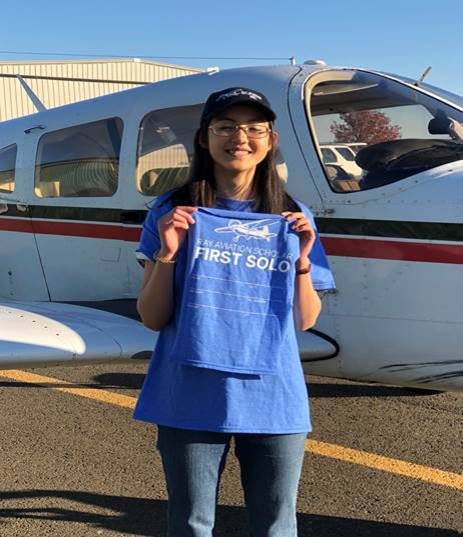
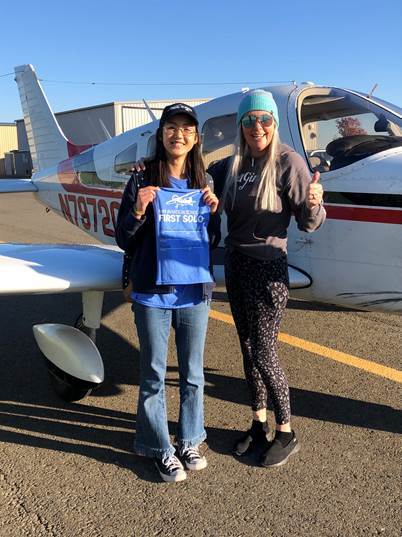
It’s with great excitement that we announce our Ray Scholar, Hannah Treehan, completed her First Solo this morning!!
| Follow us on Facebook |
It’s with great excitement that we announce our Ray Scholar, Hannah Treehan, completed her First Solo this morning!!
| Follow us on Facebook |
Topic: IFR pilots usually do not expect a WAAS or GPS failure while flying IFR let alone on an RNAV APP, what happens next?
On Wednesday, December 2, 2020 at 19:00 Pacific Standard Time (20:00 MST, 21:00 CST, 22:00 EST, 17:00 HST, 18:00 AKST, 20:00 Arizona, 03:00 GMT)
Select Number:
WP15102680
Description:
Instrument approaches have evolved greatly over the years. From the old VOR/DME approaches to ILS, and RNAV GPS approaches. With each new type of approach came more precision. GPS and WAAS-based instrument approaches have changed the way we fly. These approaches are very precise and have decreased our reliance on ground-based navigation facilities. But what happens if they fail?
San Carlos Flight Center invites Assistant Chief Pilot Brian Eliot to discuss what to do when you are flying an RNAV approach, and encounter an RNAV or WAAS failure. These RNAV approaches are easier to fly and more precise than the traditional approaches. With WAAS and GPS services available 99.99% of the time, it is hard to think about what to do if they were to fail. Sometimes failures do happen, and it is crucial that we know how to handle them.
Join us, as Brian discusses what to do and how to train for these rare occurrences. You will then be prepared to handle this outage like a pro.
Brian Eliot is San Carlos Flight Center’s Assistant Chief Pilot and resident expert for IFR training and Garmin G1000 avionics. He has been flying since 1995 and received all his training in the Bay Area. Brian previously worked as a broadcast engineer, a software developer, and taught computer science at both the undergraduate and graduate levels. He regularly presents at San Carlos Flight Center safety seminars and has a reputation for making complex concepts easy to learn and understand.
To view further details and registration information for this webinar, click here.
Topic: IMC Topics Are Taken From Real Life Events and Discussed to Aid the Decision Making Process for Pilots.
On Wednesday, December 2, 2020 at 19:00 Pacific Standard Time
Location:
online
Lincoln, CA 95648
Select Number:
WP25102675
Description:
This is an audience participation event. After a brief Audio/Video presentation we ask “What Would You Do”? Everyone is encouraged to join in the discussion. Videos depicting actual flights that encountered challenges are chosen from a library provided by EAA . Pilots of all skill levels are encouraged to attend. Click the link below for more information and to register TODAY.
To view further details and registration information for this seminar, click here.
Topic: Safety lessons from insurance company accident claim files.
On Tuesday, December 1, 2020 at 19:00 Eastern Standard Time (16:00 PST, 17:00 MST, 18:00 CST, 14:00 HST, 15:00 AKST, 17:00 Arizona, 00:00 GMT)
Select Number:
EA23102480
Description:
This lively webinar will feature a series of photos, culled from actual Avemco claim files, along with claim data specific to Avemco records. The pictures and data will focus on weather and in-motion awareness. There will also be a review of some odd-ball pilot incidents, that hopefully provide education for encounters that occur not only in the air but on the ground.
Host: Gene Benson. Presenter: Bryon Schwartz, Avemco Senior Aviation Underwriter
To view further details and registration information for this webinar, click here.

Topic: Having an understanding of in-flight illusions can help a pilot maintain positive control of their aircraft at all times.
On Saturday, November 28, 2020 at 12:00 Pacific Standard Time (13:00 MST, 14:00 CST, 15:00 EST, 10:00 HST, 11:00 AKST, 13:00 Arizona, 20:00 GMT)
Select Number:
WP15102587
Description:
In primary training, pilots learn that visual and vestibular sensations do not necessarily reflect the actual position, speed and attitude of the aircraft they fly. If not recognized and remediated promptly, the discrepancy between sensation interpretation and aircraft circumstances can lead to loss of situational awareness, with possible catastrophic consequences.
San Carlos Flight Center invites Michel Vidal-Naquet, an FAA Advanced Ground Instructor, to explain common sensory illusions such as the graveyard spin, the graveyard spiral, the leans and much more. During this seminar he will describe how these illusions lead to specific accident trajectories, and discuss how they may be recognized. Learn how to positively control your aircraft during all phases of flight, to prevent from these unexpected illusions from happening.
This exploration will help pilots intimately understand the nature of common illusions experienced during different phases of flight, how these illusions relate to specific accidents, and how they can be recognized and overcome in the future. With this knowledge, attendees can become safer pilots with a reinforced understanding of the danger of sensory illusions.
Michel Vidal-Naquet is an advanced and instrument ground instructor, and an instrument rated, commercial pilot with over 700 flight hours. He started flying in 2013 after settling in the Bay area to work as a computer scientist and engineer. His passion for aviation began during his early childhood when his family first took him on international flights. He brings a scientific point of view to his flying, and is always learning.
To view further details and registration information for this webinar, click here.
Our online monthly chapter meeting will begin at 7 pm on Wednesday, November 18th. We are going to make our November Zoom meeting a bit more of an aviation family gathering. We’ll invite everyone who can to turn on their video camera and to put Zoom into Gallery mode so they can see each other in “Hollywood Squares”. Think of a recent aviation experience you’ve had, and share it in our “Hangar Talk” time.
Our program will be a set of short aviation videos that will make you smile, laugh, and be thankful during this most unusual Thanksgiving season.
To join our Zoom Meeting, click here at 7 pm Wednesday, click here.
Meeting ID: 869 3463 4615
One tap mobile
+16699009128,,86934634615# US (San Jose)
Dial by your location
+1 669 900 9128 US (San Jose)
| Follow us on Facebook |
Topic: Analyze the weather on your route to make safe decisions—and in only 10-15 minutes!
On Monday, November 30, 2020 at 20:00 Pacific Standard Time (21:00 MST, 22:00 CST, 23:00 EST, 18:00 HST, 19:00 AKST, 21:00 Arizona, 04:00 GMT)
Select Number:
WP01102425
Description:
Weather is the most lethal of all major causes of aviation accidents.
In this 90 minute webinar, Delia will show you how to meet the FAA briefing requirements while ALSO developing skills that will allow you to make better decisions regarding flight.
Plus we’ll walk through a standard weather brief, followed by Q&A
To view further details and registration information for this webinar, click here.
Topic: FAA Safety Inspector Robert Terry Presents Updates To The Airman Certification Standards
On Wednesday, November 18, 2020 at 19:00 Central Standard Time (17:00 PST, 18:00 MST, 20:00 EST, 15:00 HST, 16:00 AKST, 18:00 Arizona, 01:00 GMT)
Select Number:
CE03102429
Description:
The presenters will discuss changes and application of the Airman Certification Standards including updates and interpretations. Viewer questions will be answered by the presenters during this LIVE program.
Specific topics that will be covered are;
• The reasons for changing from PTS to ACS
• Points of interest on ACS for;
Private Pilot-Airplane
Instrument Rating-Airplane
Commercial Pilot-Airplane
Airline Transport Pilot
Type Rating-Airplane
• The Appendices will be be covered in detail
• Additional resources
To view further details and registration information for this webinar, click here.
Topic: Preventative Maintenance is often confusing for most pilots, but perhaps we can make it less confusing by listening to an A&P.
On Saturday, November 21, 2020 at 12:00 Pacific Standard Time (13:00 MST, 14:00 CST, 15:00 EST, 10:00 HST, 11:00 AKST, 13:00 Arizona, 20:00 GMT)
Select Number:
WP15102537
Description:
Preventative Maintenance is often a topic that is confusing for most pilots, including who can perform the work, what work can be done, and how to make it legal. Mechanics work on airplanes daily and are familiar with all types of maintenance, and it’s crucial that pilots are aware of how to properly perform preventative maintenance.
San Carlos Flight Center invites A&P Tim Davis to discuss what preventative maintenance actually is, how pilots can actually perform it, and how to do so safely. In this seminar, Tim will discuss what tools you should have and how to use them safely, along with providing example scenarios based around the limitations of preventative maintenance for pilots. Furthermore, Tim will cover the basics of how to perform simple maintenance on aircraft including how to remove and install cowlings, install safety wires and cotter pins, put clamps on hoses, and including the all important logging procedure.
If you have ever wondered about how to perform preventative maintenance, or want to have a strong understanding of 14 CFR 43, this is the seminar for you.
Tim Davis is an aircraft mechanic at San Carlos Flight Center. A Bay Area native, he worked as a Quality Analyst for Electronic Arts and Blizzard Entertainment before completing aircraft maintenance training at City College of San Francisco and earning his A&P license shortly after.
To view further details and registration information for this webinar, click here.
Topic: You’ll learn methods to assess the potential hazards and how to avoid them.
On Sunday, November 15, 2020 at 20:00 Pacific Standard Time (21:00 MST, 22:00 CST, 23:00 EST, 18:00 HST, 19:00 AKST, 21:00 Arizona, 04:00 GMT)
Select Number:
WP01102424
Description:
“Weather is the most lethal of all major causes of aviation accidents.”
Former FAA Administrator
In this 60 minute webinar, you’ll learn methods to do just that. Assess the potential hazards and how to avoid them.
The top resource for assessing potential turbulence or mountain wave.
Tools that most pilots rely on—that are not reliable (and what to use instead)
How to determine if thunderstorms will be a factor
Recognizing turbulence or LLWS even when it’s not forecast.
Identifying mountain weather hazards in areas with few reporting points.
Note: When you register you will receive emails from Easy Webinar or Fly-Rite. You can easily opt-out anytime. Look for the “unsubscribe” link at the bottom of each email.
Register by going to: http://www.fly-rite.com/free-webinars